A new label-free signal checks whether subtask answers compose into the whole answer, outperforming self-consistency and semantic entropy on multi-step…
June 13, 2026·9 min read
Frequently asked questions
How much does this add to my inference bill?
For a task with n subtasks, you pay roughly one extra whole-task call plus n subtask calls, beyond what you would already pay for a decompositional agent. For small n (3 to 5), that is far cheaper than self-consistency at k=20, and it catches a different and more dangerous class of error.
Do I need to change my model or fine-tune anything?
No. The check is a wrapper around whatever model you already use. It works with closed-source models accessed by API. You only need to be able to call the model twice in two different ways: once for the whole, once for each part.
How is this different from chain-of-thought verification?
Chain-of-thought verification asks the model to check its own reasoning trace, often with a second prompt. That is closer to P(True): self-evaluation, which is known to be overconfident. Operadic consistency does not ask the model to evaluate itself. It runs the model in two structurally different ways and looks for a gap. The model is not the judge; the gap is.
The only platform to run an AI-native company.
14-day trial. No DevOps. No Sales call. Provisioned in under a minute.
Yes, and it is arguably a better fit there. A tool-calling agent that decomposes a request into tool calls already has an explicit decomposition. The composition rule is whatever the agent does with the tool outputs. You can run the whole request as a single direct query in a sandbox, run the tool chain as planned, and check that the two answers agree before taking any irreversible action.
What workflows should I not bother with?
Open-ended generation (marketing copy, brainstorming, draft writing) has no composition rule, so the check does not apply. Low-stakes internal use (summaries, notes) does not justify the extra calls. Keep the check for structured, high-stakes, decompositional workflows: that is where the cost of a confident wrong answer is highest and the signal is sharpest.
A new label-free signal catches large language model (LLM) reasoning failures by checking if subtask answers compose into the whole answer.
It does not need ground truth, a judge model, or many samples per question. You run the parts and the whole, then compare.
For operators, this is a cheaper way to flag wrong agent outputs in production without paying for human review on every run.
It outperforms self-consistency, semantic entropy, and P(True) on multi-step tasks where the model is confidently wrong.
Practical use: route low-consistency calls to a stronger model, a human, or a retry. Treat it as a circuit breaker, not a fix.
Most teams running AI agents in production have the same problem: the model is confidently wrong, and you find out from a customer. The usual confidence checks (asking the model how sure it is, sampling the same question many times, measuring how varied the answers are) all break down on multi-step tasks. A recent paper proposes a different signal, based on whether the parts of an answer actually fit together into the whole. This post walks through what it is, why it matters for operators, and how to wire it into an agent stack.
If you run an agent that books travel, drafts contracts, reconciles invoices, or answers support tickets, the failure mode that hurts you is not the model saying "I don't know." It is the model returning a clean, well-formatted, wrong answer.
Existing label-free confidence signals try to catch this:
Self-consistency: sample the same question 10 to 40 times, see if answers agree.
Semantic entropy: same idea, but cluster answers by meaning, not exact string.
P(True): ask the model "is your answer correct? yes or no" and read the probability of "yes."
These work reasonably well on single-step questions. They degrade on multi-step reasoning, where the model takes a wrong turn early and then defends that turn consistently across samples. You get high confidence and a wrong answer. That is exactly the case where an operator most needs a warning.
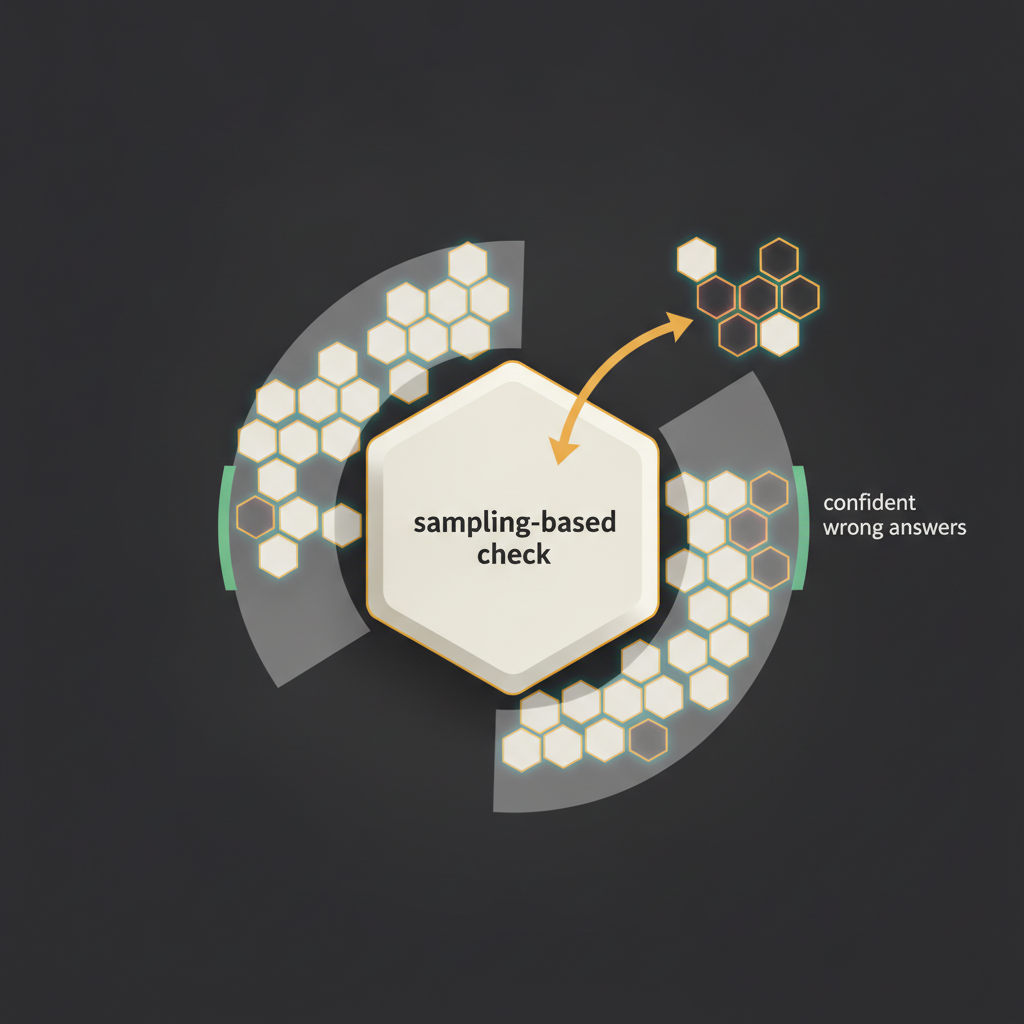
Confident wrong answers slip past sampling-based checks
What operadic consistency actually checks
Operad theory is a branch of mathematics for describing how operations compose. Forget the formal definition. The operator-relevant idea is this: if a task decomposes into subtasks, then the answer to the whole task should be consistent with the answers to the parts, combined in the prescribed way.
Concretely, for a reasoning question Q that breaks into steps S1, S2, S3:
Ask the model to answer Q directly. Get answer A.
Ask the model to answer S1, S2, S3 separately. Get a1, a2, a3.
Combine a1, a2, a3 by the known composition rule for the task (sum, concatenate, logical AND, etc).
Compare the combined result to A.
If they agree, the model is internally consistent under composition. If they disagree, something broke, either in the whole or in a part. You do not need a ground-truth answer to detect the disagreement. The signal is the gap.
The paper formalizes this as a measure over an operad of subtask decompositions. The operator takeaway: it is a check that the model's part-answers and whole-answer are mutually compatible, and it fires on exactly the cases where self-consistency does not, namely confident wrong reasoning chains.
Why this catches what sampling misses
Self-consistency asks: does the model agree with itself when asked the same question repeatedly? Operadic consistency asks: does the model agree with itself when asked at different levels of granularity? Those are different questions. A model can be stable across rephrasings of Q and still produce a whole answer that contradicts its own subtask answers. That contradiction is the signal.
How the signals compare
Here is a side-by-side for an operator. The numbers on cost are order-of-magnitude, based on what each method requires in extra model calls per question.
Signal
Extra calls per question
Catches confident wrong chains
Needs task decomposition
P(True) self-evaluation
1
Poorly
No
Self-consistency (k=20)
20
Sometimes
No
Semantic entropy (k=10)
10
Sometimes
No
Operadic consistency
2 to 5
Yes
Yes
The trade-off is clear. Operadic consistency is cheaper in calls but requires you to know how the task decomposes. For many production agent workflows, you already know that, because you wrote the prompt that asks for steps.
A minimal worked example
Let's take a concrete task: an invoice reconciliation agent that has to compute a total adjustment across three line items, then decide whether to flag the invoice for review.
# Run the whole task, then run each part, then check that# the parts compose to the whole. No ground truth required.from my_llm import askinvoice = load_invoice("INV-4471")# 1. Whole answerwhole_prompt = f"""Given this invoice, compute the total adjustmentand decide flag/no-flag. Return JSON: {{adjustment, flag}}.Invoice: {invoice}"""whole = ask(whole_prompt)# 2. Part answersparts = []for item in invoice.line_items: part_prompt = f"Compute adjustment for this line item. Return a number.\nLine: {item}" parts.append(float(ask(part_prompt)))
That snippet runs the whole task once, runs each subtask once, and checks that the parts add up to the whole. If they do not, you have a label-free warning that the model contradicted itself, and you route the invoice for human review.
The cost is four extra calls on a three-item invoice. Compare that to twenty calls for self-consistency, and you can see why this is attractive for high-volume workflows.
Where it fits in an agent stack
Most production agent stacks already have three layers: the planner that decomposes the task, the executors that run subtasks, and an aggregator that returns the final answer. Operadic consistency sits naturally as a check between the executors and the aggregator.
flowchart TD
 A[User request] --> B[Planner: decomposes into S1..Sn]
 B --> C[Executors: answer each Si]
 B --> D[Direct executor: answer whole Q]
 C --> E[Compose parts by known rule]
 D --> F[Whole answer]
 E --> G{Consistent?}
 F --> G
 G -- Yes --> H[Return answer]
 G -- No --> I[Route to stronger model or human]
The branch on the right ("Direct executor: answer whole Q") is the only new piece. You are already paying for the left branch in any decompositional agent. The extra call is the cost of the check.
When to apply the check
You do not need to run this on every call. Useful triggers:
High-stakes decisions: any action with a dollar value above a threshold, or any externally visible output.
Long chains: tasks with more than three reasoning steps, where sampling-based signals degrade fastest.
New domains: tasks the agent has not handled before, where you have no historical accuracy data.
Customer-visible outputs: anything that goes to a counterparty without human review.
For internal, low-stakes calls (summarizing a meeting, drafting an internal note), the check is overhead you do not need.
Operator implications
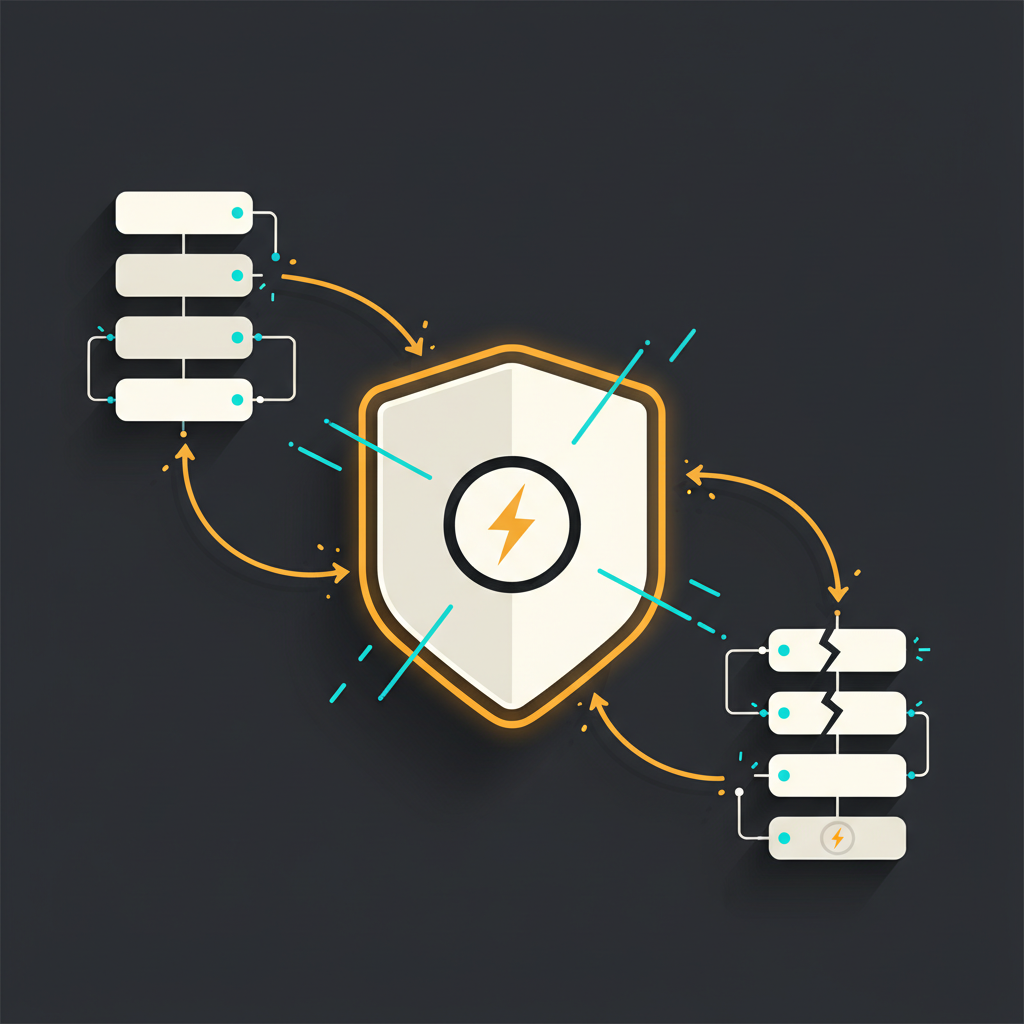
Operadic check as a circuit breaker in the agent stack
The signal does not fix wrong answers. It tells you when to not trust them. That is the operator value: a cheap circuit breaker that lets you spend human review and stronger-model calls only where they are needed.
A reasonable rollout looks like this:
Pick one workflow where confident wrong answers cost you money. Reconciliation, contract review, support escalation, eligibility decisions.
Identify the natural decomposition. If you cannot write down how subtask answers combine into the whole, the check does not apply, and that itself is a finding: your workflow is not as compositional as you thought.
Add the check as a shadow signal first. Log the inconsistency rate without acting on it. Compare against your existing quality samples.
Once the false-positive rate is acceptable, wire it to a routing rule: inconsistent calls go to a stronger model, a retry, or a human.
Eval-driven operations: what changes
If you already run evals (test sets you score the agent against), operadic consistency gives you something different: a per-call signal in production, not a batch score on a fixed test set. That changes what eval-driven operations means. You stop relying only on offline batch scores and start running a cheap online check on every high-stakes call.
That file is the operator's lever. It declares which workflows get the check, what to do when the check fires, and how often to apply it.
Limits to be honest about
Three honest limits:
The check requires a known composition rule. For tasks where the parts combine in a fuzzy way (creative writing, open-ended advice), there is no clean rule, and the signal does not apply.
It can be fooled by symmetric errors. If the model makes the same mistake in both the whole and the parts, the parts will compose to the whole, and the check will pass. Empirically this is rare but possible.
The decomposition has to be faithful. If your planner produces subtasks that do not actually cover the whole task, you will see false inconsistencies. Spend time on the decomposition prompt before you trust the signal.
These are real, and they are also tractable. The first one tells you where the check belongs (structured workflows) and where it does not (open-ended generation). The second one is why you still need periodic ground-truth evals. The third one is a prompt-engineering exercise you would do anyway.
# 3. Compose by the known rule (sum), then derive flag